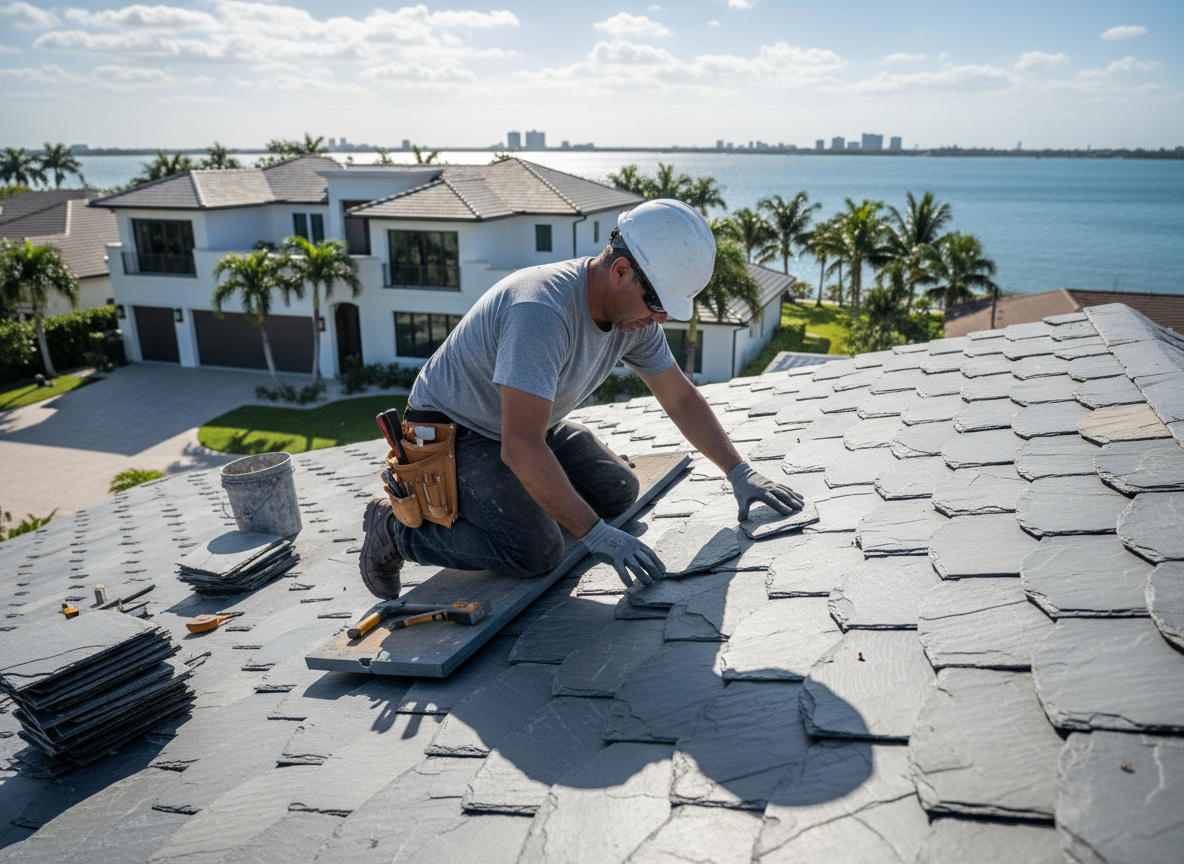
Slate roofing demands careful attention to structural support in Cutler Bay homes, many of which date from the 1970s and 1980s with trusses not originally designed for the weight. Miami-Dade County wind-load codes require enhanced fastening systems using copper or stainless clips rather than nails alone, especially on properties exposed to gusts from the nearby coast. Proper underlayment selection becomes critical because constant humidity accelerates degradation of felt layers, leading to moisture trapped beneath the slates.
Installation crews working along S Dixie Hwy often encounter older concrete-tile replacements that homeowners want swapped for authentic slate. This swap requires full deck inspection and added ridge ventilation to manage heat buildup common in south Florida. Edge detailing around chimneys and valleys must account for heavy seasonal downpours that concentrate water flow, preventing the capillary action that pulls moisture under slates during prolonged rains.
Repairs frequently involve matching discontinued slate colors from quarries that supplied Cutler Bay subdivisions decades ago. Technicians carry sample boards to verify grain and thickness on site rather than ordering mismatched material that fails prematurely under UV exposure and salt air. Flashing integration with existing stucco walls is another local challenge, as expansion joints shift with temperature swings and must be resealed with compatible sealants rated for high-humidity environments.
Technician insight
In Cutler Bay, the thing that catches most people out with Slate roofing is how our frequent afternoon thunderstorms and persistent humidity destroy standard felt underlayment within a few seasons if it isn't a high-temp synthetic rated for coastal exposure.
Storm-Damaged Slate on a 1980s Cutler Bay Home
Heavy winds tore several slates near the ridge on a single-story home off Marlin Road. Inspection revealed saturated felt and rusted nails along the south slope. Crews replaced the underlayment with synthetic membrane, reinstalled matching slate using copper clips, and added sealed step flashing at the chimney. The roof has remained leak-free through two hurricane seasons.
How it works
- 1
Site Assessment
Inspect roof deck, trusses, and existing flashing on the Cutler Bay property to confirm load capacity and identify prior moisture damage.
- 2
Material Selection
Choose slate thickness and underlayment rated for Miami-Dade wind zones while verifying compatibility with local humidity levels.
- 3
Structural Reinforcement
Add strapping or sistered rafters where needed to meet current code before any slate is installed.
- 4
Installation and Detailing
Lay slate with proper overlap, copper fasteners, and sealed valleys, then integrate ridge vents suited to subtropical heat.
- 5
Final Inspection
Check every seam and edge for water tightness and document compliance with local wind-load requirements.
Pricing
Pricing varies with roof pitch, access, and whether structural upgrades are required; upfront written quotes provided after inspection.